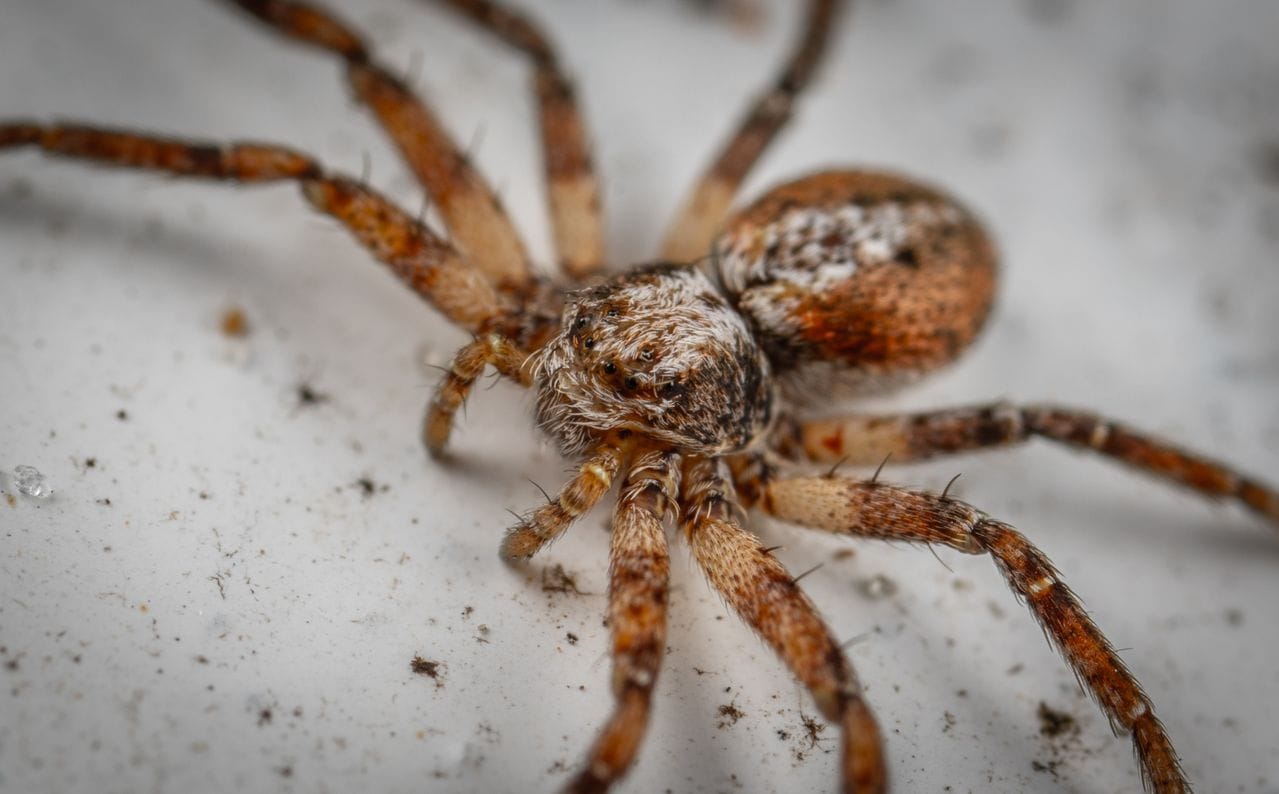
As the days get shorter and temperatures begin to drop, many UK households start noticing a familiar seasonal visitor: the house spider. From large spiders appearing in the bath to unexpected eight-legged visitors scurrying across the living room floor, autumn is often the time when these creepy crawlies seem to appear everywhere.
Known as spider season, the autumn months can bring a noticeable increase in spider sightings indoors. For people who experience a fear of spiders, even a small house spider can cause considerable distress. But why do spiders come into our homes, which species are you most likely to encounter, and what can you do to keep them out?
In this guide, Shield Pest Control explores the most common UK house spiders, explains whether they pose a risk to people, and shares practical advice on how to deter spiders and maintain a spider-free home.
Why is Autumn spider season in the UK?
Although spiders can be found throughout the year, autumn is when many households become more aware of them. There are several reasons for this seasonal increase in sightings.
Mating behaviour: Many of the larger spiders commonly found in UK homes are more noticeable during autumn because mature males leave their usual hiding places to search for females. This means you may see them crossing floors, climbing walls or appearing in unexpected places.
Temperature drops: As outdoor temperatures fall, the contrast between indoor and outdoor environments becomes more noticeable. However, the idea that all spiders invade houses to escape the cold is misleading. Many house spiders already live indoors or in sheltered areas around buildings.
More time indoors: With darker evenings and colder weather, we tend to spend more time inside our homes. This can make encounters with spiders more noticeable, particularly in rooms that are used less frequently.
Sheltered hiding places: Homes provide spiders with plenty of undisturbed areas, including lofts, garages, sheds, cupboards and spaces behind large furniture. These locations offer shelter and opportunities to catch prey.
While autumn may be peak spider season for sightings of certain species, spiders are present throughout the year. Seeing one or two in your home does not automatically mean you have an infestation.
Why do spiders come into our houses?
If you have ever wondered why spiders seem to appear just when you least expect them, there are several possible explanations.
Spiders enter buildings through small gaps around windows, doors, air vents, pipes and other entry points. Some species are well adapted to living indoors, while others wander inside accidentally or in search of a mate.
Homes can also provide a reliable supply of food. Spiders feed on insects and other small invertebrates, so a property attracting flies, moths and other insects may also provide suitable hunting grounds for spiders.
They also favour quiet, sheltered spaces where they can build webs, lay eggs or hide from disturbance. Dark corners, cluttered cupboards, gaps behind skirting boards and spaces beneath large furniture can all provide suitable hiding places.
Importantly, most spiders are not interested in people. They are generally trying to find food, reproduce or remain undisturbed, rather than deliberately seeking out human contact.
Common UK house spiders: which species might you find?
There are thousands of spider species in the UK, but only a relatively small number are regularly encountered inside homes. Here are some of the most common house spiders UK residents may recognise.
1. Giant house spider
The giant house spider is one of the largest spiders you are likely to encounter in a British home. It has a brown body, long legs and can move surprisingly quickly across floors and walls.
These spiders are particularly noticeable during autumn, when mature males leave their webs to search for females. They often live in garages, sheds, lofts and quiet corners, where they construct funnel-shaped webs.
Despite their size and speed, giant house spiders are generally harmless to people and are unlikely to bite unless handled or trapped against the skin.
2. Common house spider
The common house spider, also known as the domestic house spider, is frequently found in undisturbed areas of buildings. It typically has a brown body with lighter markings and creates tangled webs in corners, window frames, cupboards and other sheltered spaces.
These spiders help control populations of small insects around the home. Although their webs can become unsightly, their presence is not usually a cause for concern.
3. Cellar spider
Sometimes called a daddy long-legs spider, the cellar spider has a small body and exceptionally long, slender legs. It is often found in cellars, garages, lofts and other quiet areas.
Cellar spiders build loose, irregular webs and may vibrate rapidly in them when disturbed. They are harmless to humans and can catch other small spiders and insects.
4. False widow spider
False widow spiders have received considerable attention in the UK, partly because some species can deliver a bite that causes pain and localised symptoms.
They are generally dark brown or black, with a rounded abdomen that may feature pale markings. They are often found in sheltered outdoor spaces, sheds, garages and around window frames.
Although false widow spiders can bite, they are not naturally aggressive and bites are uncommon. They are often mistaken for more dangerous spiders, so identification based on appearance alone can be unreliable.
If a bite causes severe or worsening symptoms, seek medical advice.
5. Zebra jumping spider
The zebra jumping spider is a small, black-and-white spider that is commonly spotted on sunny walls, window sills and exterior surfaces.
Unlike web-building spiders, it actively hunts small insects and uses its excellent eyesight to locate prey. It may occasionally enter a home, particularly around windows and doors, but is generally harmless and can help control other small insects.
Do common house spiders bite?
One of the most frequently asked questions during spider season is whether common house spiders bite humans.
The reassuring answer is that most UK house spiders pose little risk to people, and bites are uncommon. Spiders do not feed on human skin or blood. Instead, they prey on insects and other small invertebrates.
A spider is more likely to bite defensively if it is squeezed, handled or trapped against the skin. Even when a bite occurs, symptoms are often mild, although reactions can vary.
If you find a spider in your bedroom or living room, there is usually no reason to panic. Avoid handling it directly, and use a glass and a piece of card to move it outside if appropriate.
It is also worth remembering that not every unexplained skin mark is caused by a spider. Many other factors can cause similar irritation, so it is best not to assume a spider bite without clear evidence.
Why are so many people afraid of spiders?
For some people, spiders are little more than an inconvenience. For others, seeing one can trigger intense fear, anxiety or even panic attacks.
A fear of spiders is known as arachnophobia and is a recognised specific phobia. It can cause physical symptoms such as a racing heart, sweating, shaking and an overwhelming urge to leave the room.
There is no single explanation for why people develop a fear of spiders. It may be influenced by a combination of learned experiences, cultural attitudes, family responses and the way people react to unfamiliar or unpredictable movements.
Spiders can also trigger a strong reaction because of their appearance, particularly their eight legs, sudden movements and tendency to emerge from dark places without warning.
If your fear is affecting your daily life, psychological treatments such as cognitive behavioural therapy (CBT), sometimes including gradual exposure, can help. There is no need to feel embarrassed about experiencing a genuine phobia.
Taking practical steps to reduce unwanted encounters can also help you feel more comfortable at home.
How to keep spiders out of your house
Although it is virtually impossible to guarantee a completely spider-free home, there are several practical steps you can take to reduce the likelihood of spiders entering and settling indoors.
1. Seal cracks and other entry points
One of the most effective ways to prevent spiders is to make it harder for them to enter.
Inspect your property for gaps and cracks around windows, door frames, skirting boards, pipes and external walls. Seal suitable gaps with an appropriate filler or sealant, and check that doors and windows fit properly.
Pay particular attention to damaged window seals, gaps beneath external doors and spaces where pipes enter the building.
Installing suitable insect screens can also help reduce the number of flying insects entering your home, limiting both potential spider entry points and their food supply.
2. Keep windows and doors closed when possible
During warmer weather, open windows and doors can provide easy access for spiders and the insects they feed on.
Keep windows closed when they are not needed, particularly in rooms where spiders are a concern. If you prefer to ventilate your home, consider fitting insect screens.
Check that doors close securely and avoid leaving external doors open for extended periods, especially in the evening when indoor lighting can attract flying insects.
3. Reduce clutter and tidy undisturbed areas
Spiders prefer places where they can hide without being disturbed. Reducing clutter can make your home less attractive as a hiding place and make it easier to spot webs before they become established.
Pay particular attention to:
- Loft spaces and garages.
- Cupboards and storage areas.
- Boxes, laundry piles and items stored under beds.
- Spaces behind large furniture.
- Sheds and other outbuildings.
Store belongings in sealed containers where practical, and avoid allowing piles of unused items to accumulate.
4. Dust and vacuum regularly
Regular cleaning is a simple but effective way to help deter spiders.
Vacuum along skirting boards, behind furniture, around window frames and in the corners of rooms. Remove webs as soon as you notice them, and pay attention to areas that are rarely cleaned.
Regular dusting and vacuuming can also remove dead flies, moths and other insects that might attract spiders looking for prey.
If you discover spider eggs or egg sacs, avoid handling them directly. Remove them carefully using appropriate cleaning equipment, or seek professional advice if you are unsure what you have found.
5. Reduce other insects around your home
Spiders follow their food supply, so reducing the number of insects in your home may help make it less attractive to them.
Keep food covered, clean up crumbs, empty bins regularly and address any persistent problems with flies, moths or other insects.
Check window screens, seal gaps and avoid leaving bright lights on unnecessarily near open windows and external doors, particularly where flying insects are a recurring problem.
If you are experiencing problems with several types of insects, explore our insect pest control services for further information.
6. Keep gardens and outdoor spaces tidy
Your garden can provide shelter for spiders before they enter the house.
Keep plants, shrubs and climbing vegetation from becoming overgrown around doors and windows. Move firewood, garden waste and stored materials away from external walls where practical, and keep sheds and garages reasonably tidy.
You do not need to eliminate spiders from your garden. They play an important role in the ecosystem by helping control insect populations. The aim is simply to reduce opportunities for unwanted spiders to move indoors.
Do natural spider repellents work?
Search online for ways to repel spiders and you will quickly find suggestions involving essential oils, strong smells and household ingredients.
Some commonly recommended natural repellents include peppermint oil, tea tree oil and horse chestnuts. But how effective are they?
Peppermint oil and tea tree oil
Peppermint oil and tea tree oil are often suggested as natural ways to deter spiders because of their strong smells.
Some laboratory research suggests that certain essential oils may have repellent effects on particular spider species under specific conditions. However, the evidence is limited, and there is not enough reliable scientific evidence to conclude that homemade essential oil sprays will consistently keep spiders out of a UK home.
If you choose to experiment with a natural repellent, do not rely on it as your only method of prevention. Sealing entry points, regular cleaning and reducing insect activity are more dependable practical measures.
Pet safety is important: Tea tree oil can be toxic to pets, particularly cats, and concentrated essential oils may also pose risks to dogs. Avoid spraying essential oils where pets can lick, inhale or come into direct contact with them. Seek veterinary advice before using these products around animals.
Horse chestnuts
An old wives’ tale suggests that placing horse chestnuts around window sills, doorways or room corners will keep spiders away.
Despite its popularity, there is no convincing scientific evidence that horse chestnuts reliably repel spiders. They may be an autumn decoration, but they should not be considered an effective pest prevention method.
Vinegar and homemade sprays
Vinegar and other homemade sprays are also frequently recommended online. However, their effectiveness at preventing spiders from entering or settling in a home is not well established.
Some sprays may damage certain surfaces, and homemade mixtures can pose risks to children and pets. Always consider the ingredients and follow relevant safety guidance rather than assuming a natural product is automatically harmless.
Ultimately, the most reliable approach to controlling spiders is to focus on preventing access, removing webs and reducing suitable hiding places.
Can spiders lay eggs in your house?
Yes. Some house spiders lay their eggs indoors, often in sheltered places where the egg sacs are less likely to be disturbed.
Depending on the species, an egg sac may be attached to a web, tucked into a crack or hidden in a quiet corner. If you discover one, it is not necessarily a sign of an entire infestation, but it is worth addressing carefully.
Avoid crushing or handling unidentified egg sacs with bare hands. If you are concerned about a large number of spiders or repeated sightings of young spiders, inspect nearby webs and sheltered spaces.
Removing visible webs and egg sacs, where safe and appropriate, can help reduce spider activity. If the problem persists or you are unsure which species you are dealing with, a professional pest control specialist can assess the situation and recommend suitable action.
When should you call a professional pest control service?
Most spiders found in UK homes are harmless, and a few occasional sightings can usually be managed with routine cleaning and basic prevention.
However, professional advice may be worthwhile if:
- You are repeatedly finding large numbers of spiders in the same areas.
- You discover numerous webs or egg sacs.
- Spiders are appearing despite regular cleaning and efforts to seal entry points.
- You suspect a potentially medically significant species and need help with identification.
- Your fear of spiders is making it difficult to use parts of your home comfortably.
At Shield Pest Control, we understand that unwanted pests can be unsettling. Our approach focuses on assessing the problem, identifying the pest where possible and recommending appropriate control and prevention measures.
Explore our pest control services to find out more about the support available, or visit our residential pest control page for help with unwanted pests in your home.
Enjoy a spider-free home this autumn
Spider season is a familiar feature of autumn in the UK, but it does not mean you have to share your home with unwanted eight-legged visitors.
By sealing cracks, checking window frames and doorways, reducing clutter, removing webs and keeping other insects under control, you can make your property less inviting to spiders.
Natural repellents such as peppermint oil and tea tree oil may be popular suggestions, but their effectiveness is uncertain. Practical prevention measures remain the best starting point for keeping spiders out of your house.
If spiders are becoming a persistent problem, or you would simply feel more comfortable with professional advice, Shield Pest Control can help you understand your options.
Need help with unwanted pests this autumn? Contact Shield Pest Control to discuss your concerns and find out how we can help.